Wednesday, June 15, 2016

Siena Rain and Shine


As I understand it, there are some who say that Siena rivals Florence in beauty and splendor, and does so in part because it is smaller. I will not dispute those folks except to say that we didn't give it that chance. To begin with, it was the first stop in a day bus trip into the larger Tuscany region, and we only had a few hours. Additionally, our arrival was accompanied by steady and significant rainfall. The first item on our agenda was a walking tour. Well, as you can imagine, at this point in the adventure, we did not care for Siena much. Luckily, our main tour guide was kind enough to break from the group - leaving them with the local guide - to lead those of us that were unprepared to purchase umbrellas, which helped a little. 

I believe somewhere along the way we saw one of the oldest banks in Europe. I am not sure about that though. What I am sure about is that probably at the same time that was happening I was realizing how clutch it would have been to pack an extra pair of socks. Then we made our way out of the rain and into the Duomo. Not to be confused with the Duomo. See why Florence and Siena are such rivals? Actually Duomo simply means Cathedral, and for whatever reason certain Italian cities don't specify beyond that and probably don't have to because of the splendor of these churches. Especially Florence (but I'm not allowed to say that because right now we are talking about Siena). In any case, if there was ever a magnificent place to come in out of the rain, it was inside this building; domes, pillars, artwork, mosaic floors and all:  


And wouldn't you know, when we came out of this beautiful cathedral, the sun was creeping out behind the clouds. The facade of the cathedral was equally breathtaking. 


Also in Siena is the unique Piazza del Campo; a town square shaped like a shell. Among other things, this is the site of the famous Palio: an insane horse race right in the middle of everything. I won't try to explain. Take 10 minutes to watch this feature video on ESPN, or skip to the 9:00 minute mark to see the insanity. 


All in all, I would like to come back to Siena. Our trip was too quick and too wet. But we were in Tuscany, on our way to a Chianti winery for lunch, so complaining was not really in the cards.


Onward to the Tuscan countryside, a winery lunch, and San Gimignano (the Medieval Manhattan).

Sunday, June 12, 2016

When in Rome


Thus begins my attempt to capture our wonderful trip to Italy. At the outset I must admit I feel inadequate for such a task. Actually, I think it will be easier for everyone if my wife and I just head back there and leave this recap until later. Ciao!

Alas, not yet. 

Here is my plan: one post on each city or town we visited. In some cases I will be defining city or town the way that is convenient. For example, Cinque Terre is five towns, but I will cover in one post. Also, I am going to combine Tuscany in general with San Gimignano, which is a little confusing at this juncture. I will explain. I guess we are looking at seven posts:

1. Rome
2. Siena
3. Tuscany and San Gimignano
4. Pisa
5. Cinque Terre
6. Florence
7. Venice

First up, Rome! Oh goodness.

Rome is beautiful. Rome is chaotic. Rome is overwhelming. Rome is a historical wonderland. Rome is really old. Rome is worth the hype. There is no place like Rome. From my experience (only 3 days!), here are three things to do when in Rome.

WHEN IN ROME, LEAN INTO HISTORY.

Some of the awesome things are obvious. Some need spontaneity. For example, on our first day, after essentially flying through the night (because of the time change) we hit the ground running upon arriving. Our main goal was to walk by and see the Spanish Steps (they were closed) and the Trevi Fountain (which is kind of a mob scene). In between we stumbled into two lesser known churches that on the inside looked like this:


The inside included masterpiece works of art covering the entire ceiling and walls, carefully inside the solid gold trim and intricate sculptures everywhere. Already on the first day, I felt like both a productive tourist and also an energized history buff anxious to learn more about what I just saw; the paintings, the buildings, the saints who have worshiped there over the centuries. That is, I think, the only way to experience a place like Rome. Oh, and not to forget heart-shaped pizza and a calzone the size of your head for lunch in a small little place that does pasta-making classes in the middle of the day for public viewing. That too.

The history of Rome is fairly simple, but also very extensive, mostly because it is so old. Basically, it started on a hill when two guys were born from a she-wolf or something. Then this fella named Caesar inadvertently turned an otherwise peaceful republic into an empire that ruled the civilized world with force. Eventually, the influence of Christianity, first through the life, death and resurrection of Jesus Christ, then through the ministry of the apostles like Peter and Paul who were ultimately martyred there, and then through the influence of the Emperor Constantine who established Christianity as the religion of the empire, resulted in the "conquering" of the pagan world. That only gets us to about 400 A.D. Like every other empire since creation, eventually it fell.

The rest is history. Well, the other stuff was history too, but my point is that history goes deep and wide, and even though you can say the history of a place was this or that, the truth is that there is so much history in that place you can hardly tell it all at once. So I won't try. Visiting Rome enlarged my perspective on the depth, complexity, and age of history, and I hope in the end led me more towards the who of history and not the what. Which is Jesus Christ. And in Italy, Jesus is everywhere. It is interesting to think of how present he is in places it appears not so, and sadly how absent he may be in places where he is used as the main decoration.

For example, the Pantheon. Walking around a quiet street corner after enjoying a cappuccino and cafe americano Italian style, at one of the coolest cafes in the world, and seeing a building that is 2,000 years old is as it sounds. Surreal.


What originally was a pagan temple is now a functioning church. Can you imagine having a church service in a building that was built in the 2nd century? One of the oldest man-made structures on the planet that is still standing is a place where God is worshiped regularly to this day. Remarkable.

Then, there is the Colosseum. I really enjoyed this place. We did it right: walked by it first, admired the size and the scale and smiled at the masses in line, then bought our tickets at the less-crowded Palatine Hill and backtracked through the Roman Forum, stopped for a perfect lunch, visited a couple more churches (perhaps the two best on our entire trip to Italy), and then finally entered the Colosseum after the mid-day crowds had moved on. The whole sequence before, during, and after our journey through "Ancient Rome" for us was extremely relaxing and reflective.


The Colosseum is probably the most popular tourist site in Rome, maybe the world. It is featured in blockbuster movies. Still, it really is as cool as they say. What seems to be lacking from the popularity though is the significance of this place in Christian history. Think of how many times the heavens opened around this arena to receive into glory those who spilled their blood for the sake of the Name. 

The presence and influence of Jesus and the Christian church is everywhere. I fear this is too commonplace to be experienced as it should. Though in some cases the posture of people visiting is extremely encouraging. Sometimes, the authenticity of certain artifacts or relics is questionable (more about that in Venice), but the approach to them is still very respectful and I think honoring to God. 

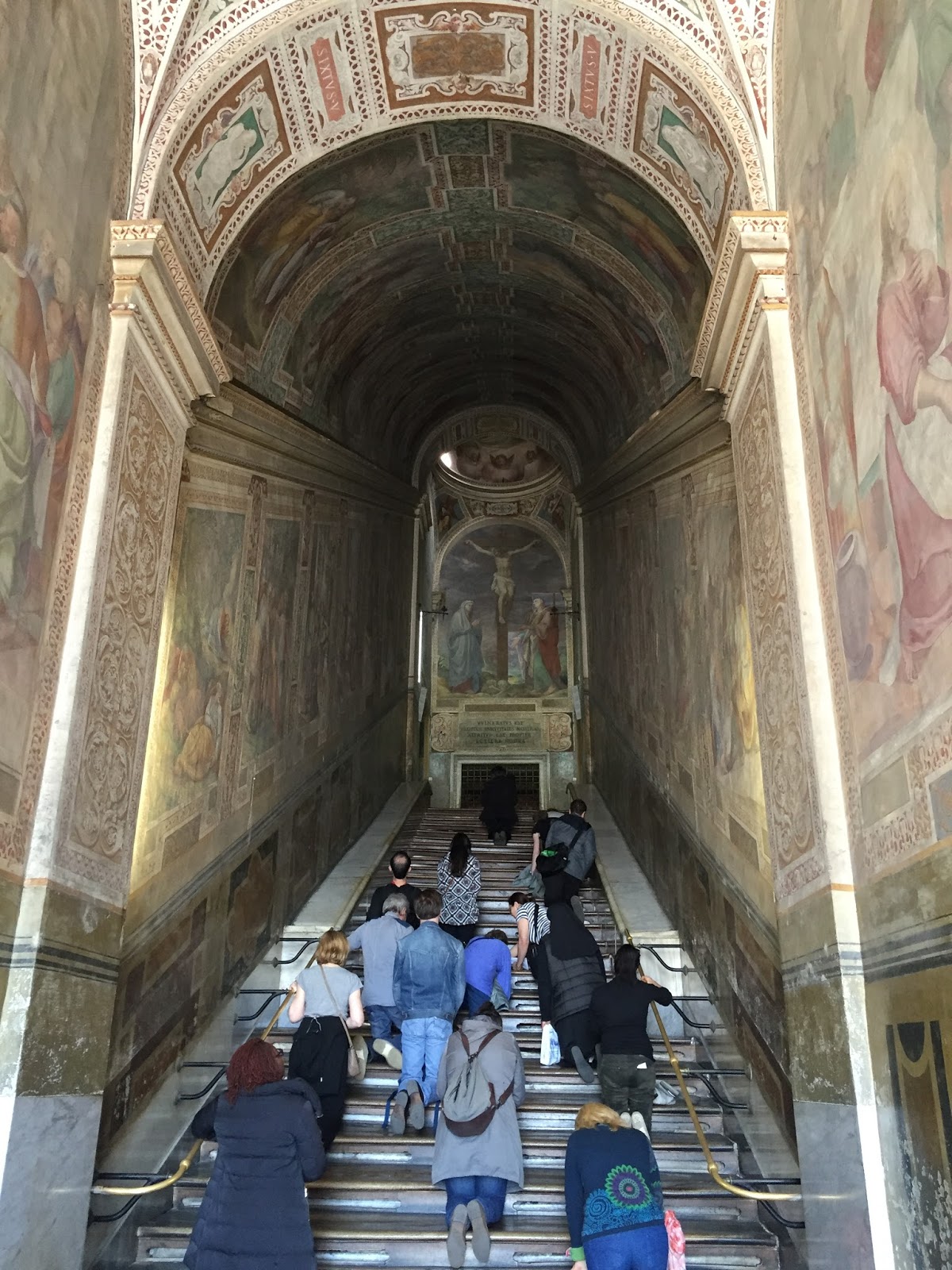
Think of it: are these really the steps that Jesus ascended while on trial with Pontius Pilate, brought to Rome in the 4th century by St. Helena, mother of the Emperor Constantine? These devout pilgrims or tourists are climbing them on their knees one at a time:


What does the Almighty God think of this famous Arch commemorating the siege and "spoils" of Jerusalem by Emperor Titus in the 1st century (can you see the menorah)? 


Where are these saints sculpted on the top of the beautiful Basilica di San Giovanni in Laterano pointing?


Rome is truly a historical wonderland. I venture to guess that the most brilliant historian is like a first grader in the context of such history, most of which points directly to Jesus.

WHEN IN ROME, GO TO TRASTEVERE.

Here is what happened. The first day, as I said, we planned a few touristy things, and our goal was to explore and relax. The second day was for Ancient Rome. It went perfect; I wouldn't have changed a thing. Our final day in Rome was reserved for Vatican City in the morning and early afternoon, and then down to Trastevere for the evening and dinner. Long story short, we spent our time at the Vatican Museums which were amazing. Especially the Sistine Chapel. Our plan to get into St. Peter's Basilica failed. Disappointed, we pressed on and found a homemade pasta to-go place (delicious and cheap!), and then made the final decision to avoid the mob inside St. Peter's Square, and head down early to this quaint little neighborhood I had heard so much about. Best. Decision. Ever. After a beautiful walk along the Tiber River, we sat outside, had some vino, and watched the world go by. Then we headed into the Basilica of Santa Maria in Trastevere and just sat, read the Bible, and relaxed. At some point we stopped for some gelato and affogato. Finally, we walked around and happily got lost on the cobblestone streets; all before settling in for a local dinner. It was fabulous.


What I'm trying to say is, when you go to Rome you have to go to Trastevere. It is where Roman culture is at its best, it is where (presumably) the earliest Christians settled, and it is delightful in every sense of the word. 

WHEN IN ROME, EAT CARBONARA. AND OTHER THINGS.

A recap of any place in Italy is not complete without a description of the cuisine. I went with a desire to specifically have carbonara - a Roman classic with pasta, eggs, pancetta, and black pepper. Funny story: here in the States I prefer it with peas, though I didn't used to like peas. As it turns out, the classic Roman dish does not include peas. How about that. Another funny story: the only place I got carbonara for my main course (I had some of Katie's another time) was on the last night. While ordering, the owner/chef called my bluff on getting a full order. After ordering a huge spread of mussels, charceturie, and caprese salad for our first course and Katie's main (cantaloupe was included in there somewhere), I wanted the carbonara. She said, "That's going to be a lot of food." I thought to myself, "Isn't this Italy?" But before a final decision was made, they put together two tables for us to accommodate the initial spread. Then, not until we had every bite consumed of our other items did she ask again if I truly wanted a full order of her famous carbonara. I said, in partial defeat, "No, just the half. Thanks."

But there is more than carbonara in Rome. While good, this last meal I described was not my best. The milk-braised veal after homemade papperdelle with asparagus and pancetta was hard to top (Katie had the papperdelle bolognese as pictured below). Artichokes were in season, so even on the side that made one meal . And when in Rome, never underestimate the quick places that offer homemade pasta to-go for 3-4 euros (as an example) or the fresh croissants at classy coffee shops. Really, everything everywhere is good. Take a look!


Next up, Siena; a smaller town in Tuscany well worth at least a day trip (even in the rain). 

Thursday, May 12, 2016

Eternal Craft


When I was early in my career at my family’s business, I was confronted with a transforming perspective on God’s purpose in business from a talk at a missions conference. Part of this purpose included to produce goods and services that will enable the community to flourish.[1]

This is more profound than simply sharing your faith with co-workers and not even referencing the nature of the work itself. A short time later, we adapted our company vision statement to take into account this larger purpose articulated at the conference. The heart of our company, where I have the privilege to be a 3rd generation owner, was already closely aligned with this, and so our adaptation was mainly a matter of articulation.

Our company name is Foamcraft. The craft has always been explained to highlight the “craftsmanship” of our work and our workers. “Hand-crafted” is ubiquitous in advertising these days, whether in bread, ice cream, soap, beer, cocktails, or coffee. I like to say “foam had the craft before the craze”, given Foamcraft was founded in 1952. Of course, the concept of craftsmanship is as old as time. God is the original and master craftsman. Jesus himself was a carpenter and spent a lifetime crafting things.[2]

God has called me to be pastoral in my workplace, witnessing to my faith in Jesus Christ and to his eternal value in daily work. As I’ve read Scripture, and listened to voices speaking into this topic, I’ve recognized that this concept of “enabling the community to flourish” is not simply referring to the community in this life. It is also in reference to the community and city in the life to come. In this way, I believe my craft is eternal.

The physical resurrection from the dead and the reality of an eternal heaven gives hope and meaning to everyday work. Our labor is not in vain.[3] I believe this means that what we craft – whether physical products like wooden toys or power tools, or through service like in an ice cream parlor, selling insurance, or preparing a meal - will last forever. It will be, as Andy Crouch says, the “furniture of heaven”[4]. What we contribute in work and culture will furnish heaven for eternity.   

This is inspiring for me because I contribute specifically to making furniture, by fabricating the foam cushions that are upholstered into the final form of what you have in your family room (or bedroom, office, pontoon boat, RV, etc.). When Jesus says he is preparing a place for us, specifically a room in his Father’s house, won’t this kind of place need furniture, which needs good quality foam? Will Jesus and I be sitting together on furniture that has Foamcraft foam?

Hold on. Am I saying that the foam cushion I sold last week for a finished chair that hopefully will soon be brought home by a lucky customer, will be in heaven? Well, no. I’ve seen that used recliner on the side of the road, and that is not the picture of the new earth that is in the bible. At the same time, is there not something about what my work contributes to the product that will last as part of redeemed creation? I believe from the Bible that there is.

Consider the following. Paul says in Colossians 1 that all things were created by, through, and for Jesus, and that he is before all things and in him all things hold together. And through him God was pleased to reconcile to himself all things. What things? All things. God is reconciling more than my body and soul to himself?

In Revelation 21, we see that kings will bring into the New Jerusalem the glory and honor of the nations. What is this glory and honor? There is mention of “jewels”. Jewels are minerals which require skilled eyes and hands to refine into their final form. Andy Crouch in his book Culture Making, highlights the fact that jewels, therefore, are minerals plus culture.[5] Crouch asks, “Will the cultural goods we devote our lives to – the food we cook and consume, the music we purchase and practice, the movies we watch and make, the enterprises we earn our paychecks from and invest our wealth in – be identified as the glory and honor of our cultural tradition?”[6]

Could the physical results of our work be redeemed and part of the physical new heavens and new earth? N.T Wright, in Surprised by Hope, explains it this way: “The transition from the present world to the new one would be a matter not of destruction of the present space-time universe but of its radical healing.”[7] This is a wonderful promise for us! Tom Nelson, in Work Matters, says, “If our daily work, done for the glory of God and the common good of others, in some way carries over to the new heavens and the new earth, then our present work itself is overflowing with immeasurable value and eternal significance.”[8]

To those who do not yet know Jesus personally, and perhaps doubt that there is a life to come, this is a show-stopper. Tim Keller in Every Good Endeavor says, “If this life is all there is, then everything will eventually burn up in the death of the sun and no one will even be around to remember anything that has ever happened. Everyone will be forgotten, nothing we do will make any difference, and all good endeavors, even the best, will come to naught.”

Pause for effect. What? Keller continues, “Unless there is God. If the God of the Bible exists, and there is true reality beneath and beyond this one, and this life is not the only life, then every good endeavor, even the simplest ones, pursued in response to God’s calling, can matter forever.”[9]

This the bible proclaims to us: not only is there God, but this God establishes the work of our hands (our craft), gives it value, and through his resurrection power shown forth in Jesus is redeeming our craft into eternity.


[1] Jeff Van Duzer, Urbana 2006
[2] Tom Nelson, Work Matters, p. 89-90
[3] 1 Corinthians 15:58
[4] Andy Crouch, Culture Making, p. 170
[5] Crouch, p. 175
[6] Crouch, p. 171
[7] N.T. Wright, Surprised by Hope, p. 122
[8] Tom Nelson, Work Matters, p. 73
[9] Tim Keller, Every Good Endeavor, p. 29

Originally posted at the College Park Blog 

Wednesday, December 23, 2015

Incarnation and the Body of Death


"Wretched man that I am! Who will deliver me from this body of death? Thanks be to God through Jesus Christ our Lord!" - Romans 7:24-25

"And you, who once were alienated and hostile in mind, doing evil deeds, he has now reconciled in his body of flesh by his death, in order to present you holy and blameless and above reproach before him." - Colossians 1:21-22

I was struck by the connection I saw in the cry of Paul in Romans 7:24-25 for deliverance from this “body of death”, and the affirmation by Paul in Colossians 1:21-22 that we are reconciled through Jesus in “his body of flesh by his death”. I was also encouraged with the apparent link to the incarnation, helped by the writings an old voice from the 4th century church.

Paul does not just say “thanks be to God” in Romans 7. He also says “through Jesus Christ our Lord”. And, from other places in Scripture, we know that he does not just mean through Jesus as if through a supernatural miracle that mysteriously delivered us from a sinful body and reconciled us to a holy God. He does not just mean through an appearing or a presence. He means through a physical human body and a physical human death. The only way we could be delivered through Jesus, and reconciled, is if it happened through a human body without the sin corruption that we have. It couldn’t have happened through the Spirit, even though the Spirit is without sin. It couldn’t have happened through Jesus appearing as the Son of God only. And it couldn’t have happened through Jesus as a man if he shared any part of our sinful nature. It had to have been through God, in a body of flesh, without sin, through actual physical death. How amazing was the incarnation of the Son of God, and Him taking on our likeness! The incarnation (Christmas), is the miracle that made our deliverance possible. And then the resurrection (Easter), is the miracle that makes our deliverance actual and eternal.

Athanasius explains this idea in his classic work “On the Incarnation”. While these words are translated for the benefit of the “modern reader”, and is according to C.S. Lewis, “written so deeply on a subject with such classical simplicity,” it is still a very lofty arrangement of profound sentences. I pray that the depth and even complexity of these words would stretch your mind and fill your soul, as you contemplate the simply reality that Jesus had to come to earth as a human and die as a human to deliver us from our humanness, which was stained with the corruption of death. Then He rose from the dead to conquer that death forever! Here is St. Athanasius “On the Incarnation”:  

“The Word perceived that corruption could not be got rid of otherwise than through death; yet He Himself, as the Word, being immortal and the Father’s Son, was such as could not die. For this reason, therefore, He assumed a body capable of death, in order that it, through belonging to the Word Who is above all, might become in dying a sufficient exchange for all, and itself remaining incorruptible through His indwelling, might thereafter put an end to corruption for all others as well, by the grace of the resurrection. It was by surrendering to death the body which He had taken, as an offering and sacrifice free from every stain, that He forthwith abolished death for His human brethren by the offering of the equivalent.”

“For naturally, since the Word of God was above all, when He offered His own temple and bodily instrument as a substitute for the life of all, He fulfilled in death all that was required. Naturally also, through this union of the immortal Son of God with our human nature, all men were clothed with incorruption in the promise of the resurrection. For the solidarity of mankind is such that, by virtue of the Word’s indwelling in a single human body, the corruption which goes with death has lost its power over all. You know how it is when some great king enters a large city and dwells in one of its houses; because of his indwelling in that single house, the whole city is honored, and enemies and robbers cease to molest it. Even so it is with the King of all; He has come into our country and dwelt in one body amidst the many, and in consequence the designs of the enemy against mankind have been foiled, and the corruption of death, which formerly held them in its power, simply ceased to be. For the human race would have perished utterly had not the Lord and Savior of all, the Son of God, come among us to put an end to death.”  

- Page 35, Popular Patristics Series, St. Athanasius, On the Incarnation, SVS Press

Saturday, November 14, 2015

Read a Full Meal


I do a lot of reading on a given day. In my armchair at home (like Bilbo Baggins), at work, on a bike ride in front of the laundry mat in Key West. You know, whenever I can. Sometimes I worry whether I am also simultaneously doing a lot of learning. Or perhaps I am reading at the expense of thinking, and therefore not learning. This would be very bad. It occurred to me that one way for me to process my thinking and therefore evidence my learning is to share about my readings. Consider this an introduction to that.

One of my philosophies about reading is that it needs to be done in healthy-sized chunks. The internet and social media can be terrible for the mind as it applies to reading. Popcorn style reading is disastrous. This existing philosophy about reading a lot at a time, say, at least a chapter of a book in one sitting, or a chapter of Scripture instead of a couple verses, or a whole article or even page in a newspaper instead of only the first paragraph, revealed itself specifically this last weekend as I was reading a book about my favorite topic. I want to use my experience reading this book to make a point. That is, I want to help you read a full meal. How do I do that wait what does that even mean? When you read, you need to do so fully by practicing the same basic things you would do when eating a full meal: chew, swallow, and digest.

CHEW

This does not mean put the pages of a book into your mouth and bite down repeatedly. Don't be silly. What I mean is actually take in words and sentences so that they can get into your system. Just like you shouldn't just look at your food, play around with it on the plate, or smell it only, don't just look at the pictures, play with the pages, or take in the smell (old books can be distracting in this way). This sounds painfully obvious but I mention it because I need this reminder. I am a book lover, and a collector, and I do sometimes sit and admire my shelves, "tinker" through a book I want to someday read, or literally open and smell a 19th century volume of The Treasury of David by Charles Spurgeon (just picked up for $8 at Half-Price Books #FistBump). I digress.

The book I mentioned before is called The Heavenly Good of Earthly Work. I was pleasantly surprised to find that it was a "theology" book that was quite a page turner. Sometimes, even with topics that particularly interest me, I find myself struggling to get through the pages. In some cases too much thinking is required and comprehension is difficult, so I have to go slow, which can be frustrating. Some books are so dense that to actually read them intelligibly its like you're eating your peas one a time. This is not chewing (and extremely annoying). With this book I found myself breezing through the pages because the "argument" or "thesis" that was being presented needed a lot of words to fully explain. By truly chewing the content I tasted it more keenly and enjoyed it more thoroughly.

SWALLOW

As I read through the paragraphs, I was on the edge of my seat for the point that was being built, through page after page of introductory context. It wasn't that more words were used than necessary; layers of thought had to be built before a complete point could be made, and in this case that approach worked well and was helpful for me. The length and the completeness was worth the effort, like a long meal at a nice restaurant. But I couldn't have understood or benefited from any of it without making it to a reasonable stopping point. I needed to swallow a healthy portion.

Reading is not scanning information into your brain long enough to process it and then spit it back out. It is meant to be swallowed so it can fully make it into our system. How much time do we spend reading only to stop mid-sentence, mid-paragraph, or mid-chapter? Or mid-email?? Its like the book or article is having a conversation with us and we just walk away in the middle of a story. You wouldn't do that in real life. As a society we need to improve our attention spans. Mental snacking is contributing to poor overall health. We need to swallow what we are reading, rather than swish it around in our brain for a minute or two and then spit it back out. I shudder to think of the affect on our comprehension, cognitive development, and soul growth that this has on us. For Christians, this leads to ignorance in areas where we need to be speaking life into people.

This is very convicting to me because I often falsely find my identity in what I know, and if I don't know a little about a lot I don't like where that leaves me. What I've found is the only way to know a little about a lot is to read too little about everything. Bad idea. Better to know a lot about a little by reading as much as you can about only some things. Follow? I am guilty of doing this completely wrong; scanning articles, reading parts of books only (although the table of contents can be a helpful summary). I've been reading The New York Times for a year, and I would have trouble telling you what I read yesterday. This is no good.

I admit I still go for the snacking instead of the meal. Worse, I don't even always ingest what I'm reading. Its like "eating" sunflower seeds. This is not what reading should be. We need to swallow the information and ideas that our eyes see and our brain is processing.

DIGEST

Finally, we need to digest what we read. We need to let our brain do its work and help us process, store, and use what we've just ingested. If we did it right, and fully chewed it, and swallowed it, there is a lot of internal work left to be done. The last thing we would want is to go on to something else without thinking about what we just read!

We can't expect to understand a complex subject or current event without reading and thinking a lot about it. If you read a Bible verse from a different chapter or book every day, your perspective on God and the gospel is going to be very scattered. If you read one article about the Syrian refugee crisis you probably aren't going to know that much about what all is really going on there. If you watch one episode of 24, you have no appreciation yet for how amazing it is. I digress again.

But is it possible to read a book as a full meal, especially considering the amount of time that is realistically available to read? What about the newspaper? Or the Bible? Now we're talking. Are we snacking on the Bible instead of taking it in as a gourmet meal? God forbid.

"Why do you spend your money for that which is not bread, and your labor for that which does not satisfy? Listen diligently to me, and eat what is good, and delight yourselves in rich food." - Isaiah 55:2

Diligence is required. Here is my challenge: take at least a quarter of as much time thinking as you do reading, and no less. In other words, if you read for an hour, make sure you are also just thinking for at least 15 minutes in the same sitting. Start with the Bible (I am talking to myself here).

If meditation, prayer, and journaling (as a way to document what you are learning or how you are changing) results, you are in a good place. If a wandering mind, aimless searching on your phone or the internet, or the temptation to multi-task is the result, go back to reading until it causes you to think (undistracted) for at least a quarter of the time. And repeat. I think this will prove whether your reading is helping you learn and change or is just a leisure activity. Leisure reading is not bad, but there is so much more to experience. Don't move on just yet to other things. Digest it. If you didn't digest the food you ate, you would feel ill. It is the same with what we feed into our brain, only this digestion is not involuntary, so you have to consciously do it, and the negative result if often less obvious, so we don't address it.

A possible future post: "what if I don't like to read?" Ahh! I pity the fool. Not that you're a fool if you don't like to read. I'm just sayin'. You need to start reading more and I promise you will love it.